
Surprising statistic to start: exchanges that combine centralized custody with Web3 access—like OKX—typically require both KYC and mandatory two-factor authentication, a combination that materially changes how you manage access and risk. For traders in the US this is not a bureaucratic detail; it shapes how you can: (1) open an account, (2) move assets between custody models, and (3) recover access after a device failure. This article breaks down the mechanisms behind OKX login, compares alternatives, and gives practical heuristics you can use the next time you need to sign in, trade spot, or shift into a self-custodial wallet.
Read on if you want to move past the checklist mentality (username, password, 2FA) and understand why those steps exist, where they fail, and how to design small operational changes that materially reduce the chance of lockout, theft, or regulatory surprise.
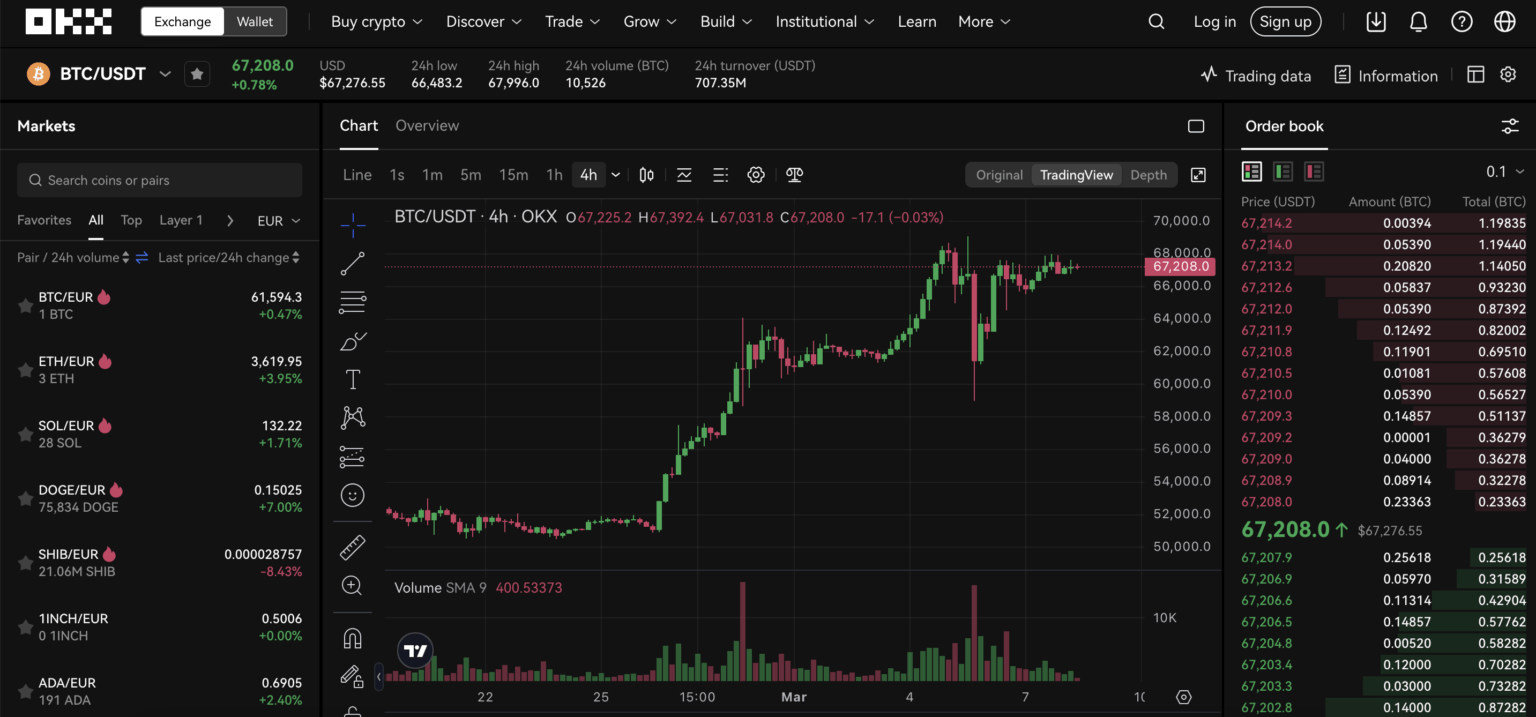
How OKX Login Works: Mechanisms, not magic
At an operational level, OKX login ties three systems together: identity verification (KYC), authentication (password + 2FA/biometrics), and device/session risk scoring (AI-driven threat detection). KYC connects a human identity to an account, which enables fiat rails, withdrawal limits, and regulatory traceability. Authentication proves you control the account at a given moment. Risk scoring monitors when logins look unusual and can trigger additional verification or temporary freezes.
Mechanically, OKX uses mandatory KYC and multiple 2FA options—SMS, Google Authenticator, and biometrics on mobile—so the failure modes differ. If you lose your phone, SMS-based recovery can be quick but exposes you to SIM swap attacks. Authenticator apps are resistant to SIM threats but require either keeping a safe backup of your seed or using platform-supported account recovery procedures. Biometric login on mobile adds convenience, but it’s only an extension of the account’s device trust: if that device is stolen and not protected by a strong lock screen, the biometric factor can still be bypassed indirectly through device-level vulnerabilities.
Spot Trading and Login: Why access equals optionality
Spot trading on OKX is straightforward conceptually—buy low, sell high—yet the practical constraints are often access-related. To place a market or limit order you must be logged in, of course, but you also need the right custody model and sufficient cleared balances. OKX separates a custodial centralized account (the exchange) from a non-custodial Web3 wallet. Logging in returns you to a session where you can move assets between these two models, stake assets, or use the DEX aggregator for swaps across over 130 blockchains.
This separation matters because execution risks differ across custody types. On the exchange, you trade with deep order books and high intra-day liquidity for major assets (BTC, ETH) and many stablecoins. In the Web3 wallet, trades depend on on-chain liquidity and are subject to slippage and gas. When you log into OKX to spot trade, you’re choosing an execution venue with implicit trade-offs: centralized speed and order-book liquidity versus decentralized composability and custody.
Trade-offs: Security, Convenience, and Regulatory Friction
There are three competing priorities at sign-in: security (prevent unauthorized withdrawals), convenience (fast trade execution), and regulatory compliance (KYC/AML). OKX deliberately tilts toward security and compliance. Over 95% of user assets are held in air-gapped, multi-signature cold storage—this lowers systemic theft risk but introduces withdrawal latency when large amounts need manual approval. Proof of Reserves provides transparency, but it doesn’t change your login hygiene; it only reduces counterparty risk by showing backing on-chain.
If convenience is your priority—say you scalp on short-term inefficiencies—you’ll value biometric mobile login and a pre-funded custodial account. If minimizing counterparty custody is your priority, you’ll favor the Web3 wallet path, but that shifts the burden to you: losing a seed phrase is irreversible. The middle path is to keep trading capital on the CEX and long-term holdings in a hardware-backed self-custodial wallet integrated with OKX.
Where OKX Login Breaks: Limitations and real failure modes
No system is perfect. Here are practical limits US traders should know: first, mandatory KYC means anonymous, quick entry is impossible; that’s a feature for compliance, a bug for privacy. Second, two-factor mechanisms reduce theft but introduce recovery complexity—losing both your phone and seed backup can lead to permanent account loss or lengthy customer-support escalations. Third, AI threat detection reduces fraudulent access but can false-positive on legitimate logins from new VPNs or travel, creating friction during critical market windows.
Recent spot-pair delistings (this week OKX removed several smaller pairs) are a reminder that asset availability is dynamic; being logged in does not guarantee continuous access to trade a given token. Delistings are routine risk-control measures to preserve market quality but can strand positions if you treat low-liquidity assets as equivalent to blue-chip coins.
Practical checklist and heuristics for US-based traders
Here are decision-useful rules you can implement immediately:
1) Prefer an authenticator app, not SMS, for 2FA on primary accounts. If you use SMS, limit large withdrawals with additional device whitelisting.
2) Split roles: keep a small intraday trading balance on the custodial account and store long-term positions in the Web3 wallet or hardware wallet. This reduces the blast radius of a single compromised login.
3) Back up KYC and recovery materials securely. For US users, make sure the government ID used for KYC is current to avoid verification delays; scanning quality matters during remote KYC checks.
4) Use device-level protections: strong passcodes, full-disk encryption, and OS updates on hardware used for trading. Biometric login adds convenience; never use it as the only layer of defense.
5) Test recovery flows before you need them. Create a low-risk scenario to walk through account recovery with OKX support so you understand timeframes and documentation requirements.
For a concise jump-start on OKX login procedures and platform navigation, you can consult this guide: https://sites.google.com/cryptowalletextensionus.com/okx-login-web/
Comparative view: OKX versus two plausible alternatives
Compare three archetypes for a trader in the US: (A) full custodial exchange (like OKX), (B) pure self-custodial wallet with DEXs, (C) hybrid approach (CEX + hardware wallet). OKX’s model (A) gives fast order execution, integrated fiat on-ramps, and advanced charting with margin and derivatives up to high leverage—but requires KYC and central counterparty trust. Self-custodial DEX trading (B) maximizes privacy and control but suffers from on-chain latency, slippage, and composability risks. The hybrid (C) sacrifices some speed and convenience for greater security: keep trading and liquidity on the CEX, move long-term holdings to hardware-backed wallets. For most US retail traders, the hybrid path balances regulatory realities and security needs.
Each choice sacrifices something: privacy for legal access, speed for control, or simplicity for resilience. Your preferred balance should depend on time horizon, position size, and tolerance for regulatory friction.
What to watch next (signals, not predictions)
Watch four signals that will affect how OKX login matters for you: shifts in US regulation of exchanges and on-ramps (which could tighten KYC and FI reporting), improvements in device-level authentication standards (passkeys), changes in Proof-of-Reserves transparency practices, and platform-level asset listings/delistings. Delistings of niche spot pairs this week reflect a continuing housekeeping process; monitor liquidity metrics rather than headlines if you hold small-cap tokens.
If regulatory pressure increases, expect longer verification queues and possibly stricter withdrawal flags for new accounts. Conversely, improvements in account-recovery UX or broader adoption of passkeys could reduce the friction of secure logins without compromising safety. These are conditional scenarios: the mechanisms—laws, tech standards, and exchange incentives—will determine which outcomes are likely.
FAQ
Q: If I lose my phone, what’s the fastest way to regain access to OKX?
A: The fastest path depends on your chosen 2FA. If you used an authenticator app, restore from the authenticator backup or move the app to a new device using the app’s recovery procedure; if you used SMS, contact your carrier and OKX support. Pre-registering backup codes or a secondary 2FA method dramatically shortens recovery. Test your recovery plan during low-risk times so you know the timelines and documents OKX requires for identity re-verification.
Q: Should I move everything into OKX’s Web3 wallet to avoid custodial risk?
A: Not necessarily. The Web3 wallet gives you private-key control, which eliminates custodial counterparty risk but introduces self-custody risks: lost seed phrases are irreversible, and smart-contract interactions can be exploited. For many users the practical approach is to keep active trading balances on the exchange and move long-term holdings to a hardware-backed self-custodial wallet.
Q: How does mandatory KYC affect my trading and privacy if I live in the US?
A: KYC enables fiat rails and larger withdrawal limits but ties your identity to your trading activity on the platform. If privacy is a primary concern, you should evaluate the trade-offs: decentralized on-chain trading provides privacy advantages but at the cost of convenience, liquidity, and sometimes higher fees. KYC compliance is a regulatory reality for most major exchanges serving US users.
Q: Are OKX logins secure enough for high-frequency or institutional trading?
A: OKX offers institutional-grade features—cold storage, multi-sig, Proof of Reserves, and AI threat detection—which are broadly aligned with institutional security needs. For high-frequency trading, session stability, low latency connections, and dedicated APIs matter more than the user login UI. Institutions often add IP whitelisting, API key permissions, and segregated accounts to reduce operational risk.
Final practical takeaway: treat login as the first line of trade execution risk management. A secure, tested, and redundant login strategy—authenticator apps with secure backups, device hygiene, and a custody plan that matches time horizon—will reduce the chance that the next market move happens while you’re locked out. That’s often the difference between an avoidable loss and a painful lesson.